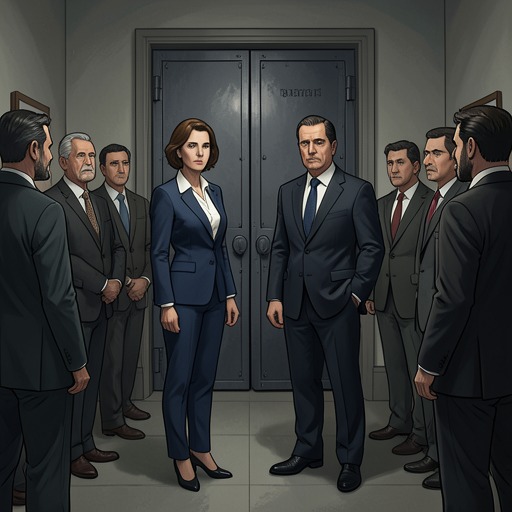
Bea Falls from a Wall at the Andrada Estate and Meets Diego
Gente que viene y ¡Bah!Bea Falls from a Wall at the Andrada Estate and Meets Diego is the chance encounter that brings Bea and Diego into direct contact. What begins as a solitary walk beside the sea becomes a humiliating fall, an awkward rescue, and the recognition that Diego’s daughter has already formed an impression of Bea. The scene turns Bea’s curiosity about a stranger into an encounter neither of them can treat as entirely anonymous.
Setting and Approach
Bea is walking on the beach at night, carrying the disappointment of her recent experience in architecture. At thirty-one, after two years that seemed to have taken her further from what once drew her to the profession, she is wondering whether to choose another future; designing lamps has even crossed her mind. The beach offers a different kind of attachment. She misses it in a way that cannot be answered by a telephone call, unlike her intermittent longing for her family or her accustomed life in Madrid.
The cold water sends her back from the shoreline almost as soon as she steps into it. Now barefoot, with sand on her feet and no way to shake it off, Bea looks inland at the houses close to the beach. Her thought about coastal restrictions is not presented as a considered environmental objection: she admits that envy is closer to the truth. She resents that other people live so near the sea while her family does not. That glance leads her to the Andrada Estate, whose proximity to the water makes it an object of attention before Diego himself appears.
The Estate at Night
Under the full moon, Bea can see the large early-twentieth-century house clearly. She regards it as the most beautiful building in Cantabria: stone walls, broad white wooden galleries, and grounds extending across hundreds of hectares. The galleries are painted and repaired each year to resist the salt air. The estate’s carefully kept grounds include centuries-old chestnuts, cedars, oaks, and other trees Bea cannot identify. These details make the property seem composed and enduring, in contrast with the disquieting activity she notices beside it.
A pink Mercedes parked near an oak catches Bea’s attention. She has seen the car before and connects it to the man with the child in his arms, the man she remembers from a puzzle, but she is certain that he is not part of the Andrada family. She wonders whether the estate has been sold and thinks that Irene, as mayor, might know. When the house door opens, the man comes out wearing a tracksuit and carrying an enormous plastic bag. He puts it in the car’s trunk, gets into the vehicle, and then does not drive away. Bea watches for several minutes. His stillness leaves her without an explanation, and the unanswered question draws her closer.
The Fall and Rescue
Bea knows that investigating is none of her business and that she has other problems to think about, but curiosity wins. The stone wall blocks her view of the car, so she climbs it barefoot. The uneven, pointed stones hurt the soles of her feet as she tries to get high enough to see over. From there she can watch the man strike the dashboard in anger. The sight frightens her, but not enough to make her leave. Instead, she climbs farther, and the man turns towards her.
Trying to retreat before he sees her, Bea steps back, loses her balance, and falls from the wall. She hits her head and body, badly hurts her back, and catches her trousers and sweater in a bramble. Her right foot slips into a gap after she steps on something that breaks. When she hears the gate opening, she assumes the man is coming to find her. Pain and panic make it difficult even to get her sweater off, and she ends up pretending to be unconscious, her face hidden beneath the fabric. The pose is both an attempt to avoid the consequences of being caught and an absurd extension of her paralysis.
Diego finds her and asks whether she is all right. Bea remains silent at first, then describes her pain as being everywhere: her foot, back, backside, and head. He helps her stand, lifting her carefully and using his foot to free the trousers from the brambles. The fabric tears in the process, costing Bea a pair of trousers she says were worth two hundred euros. Once upright, she feels her injured back and sees blood on her fingertips; she is also slightly dizzy. The stranger’s practical assistance turns a trespass into an intimate, if uncomfortable, moment of dependence.
Recognition and the Encounter’s Turn
After Bea says she lives nearby and declines his offer to get alcohol, Diego studies her and recognizes her from the train. The recognition is confirmed through his daughter: she has drawn the woman from the train with horns and a tail. The detail gives Bea an unexpected place in Diego’s family life before she has even learned why he is at the estate. It also makes the encounter more pointed than a meeting between two strangers; Diego’s household has already carried an image of Bea forward, in a child’s unflattering but memorable form.
Their exchange does not resolve the questions that first brought Bea to the wall. The scene does not explain why Diego sat in the car or what the plastic bag contained. Instead, it changes the immediate question from what he was doing to what Bea herself was doing there. Diego asks whether she often climbs other people’s walls, then presses her to explain her purpose. Bea considers the moment an opportunity to be clever and answers by identifying herself as an architect. The reply does not undo the fall or provide a practical explanation; it converts her profession into a comic response to a plainly incriminating situation.
The scene’s movement is from distance to exposure. Bea begins alone, watching the Andrada Estate from the beach, and ends injured under Diego’s attention, unable to hide either her presence or her curiosity. Her bruised body, torn clothing, and bloodied fingertips make the intrusion materially consequential; the daughter’s drawing gives the meeting a personal afterlife beyond the rescue. The chance encounter is therefore both comic and consequential: Bea falls while trying to observe Diego, but the fall brings them into conversation and establishes that he already knows who she is.